If I was asked to give a TED talk ...
Applying my degree work, technical fluency, and learning systems to areas that I am passionate about. Currently moving towards supporting sustainable materials decisions, from transport phenomena to material selection and test design.
Chemical engineering · materials science · systems · sustainability
Built for teams that need rigorous translation between technical concepts and accessible product strategy.

Literature review: 50+ materials assessed
Bio-based soft materials study
At FGE NexantECA, I led two initiatives into sustainable materials: one exploring novel textiles, the other on bio-based packaging. The work spanned over 50 materials, mapping how each one is made, what it's used for, and where room for growth sits. Three themes kept surfacing:
-
Bio-based fibers
Mycelium, hemp, bamboo
Mycelium is the most novel of the three, since hemp and bamboo are already well-established. But "bio-based" doesn't guarantee biodegradable: these fibers are often processed with solvents and coatings that quietly undo the very premise they're sold on. The opportunity, as I see it, isn't really in the fiber; it's in reformulating what we coat it with.
-
Sustainable packaging
Seaweed films, PLA, PHAs, paper composites, compostable coatings & packaging
Bio-based packaging has made huge strides lately, with PLA now one of the most common bio-polymers on the market. But for all their good intentions, these materials are frequently mistaken for their petroleum-based look-alikes in recycling systems, which drags down the quality of recycled plastic overall. I think both sides win if material recovery facilities get better at telling them apart.
-
Material circularity
Mechanical recycling, chemical recycling, textile sorting, closed-loop systems
Circularity is the goal everyone claims to be chasing, but the systems meant to support it are still catching up. Textile recycling facilities struggle to sort blended fibers, and "closed-loop" processes often lean on harsh chemicals. That said, a handful of companies are pushing this forward with things like AI-assisted sorting and thermal separation tech. I still believe the best progress happens at the consumer level: minimizing consumption, reusing, repairing, and upcycling.
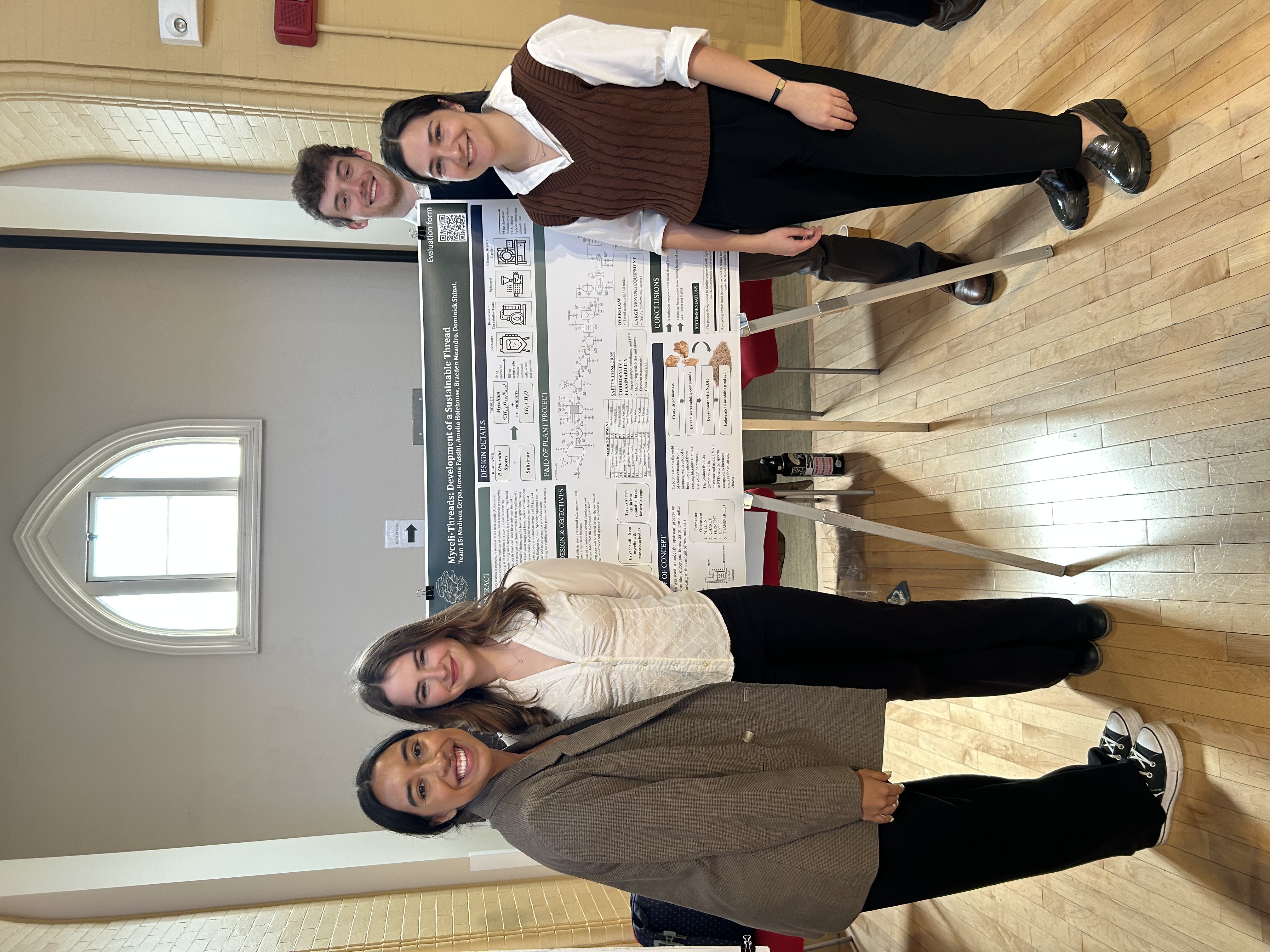
Final product: capstone poster session
Mycelium Thread Plant Model
Task at hand-
1
As part of my capstone project, my final undergrad assignment, my team and I took on the challenge of creating a novel substrate to improve mycelium growth.
-
2
Research led to the discovery that mycelium substrate growth was already highly efficient, but limited. We modified the problem statement to instead develop a novel textile that could be made with mycelium.
-
3
Chitin makes up a large percentage of mycelium mass, with cellulose making up most of the rest, so the group decided chitin would be our working material.
-
4
We ran a lab experiment to extract chitin from oyster mushrooms, and it worked.
-
5
I did a literature review to model a continuous operation facility that could extract the chitin and extrude it through a proprietary solvent to make a final thread product.
-
6
While novel technology can be very exciting, it often takes far more time than expected to become commercial or scalable. Good ideas are plentiful, but turning one into any color of success takes a lot of work and iteration.